

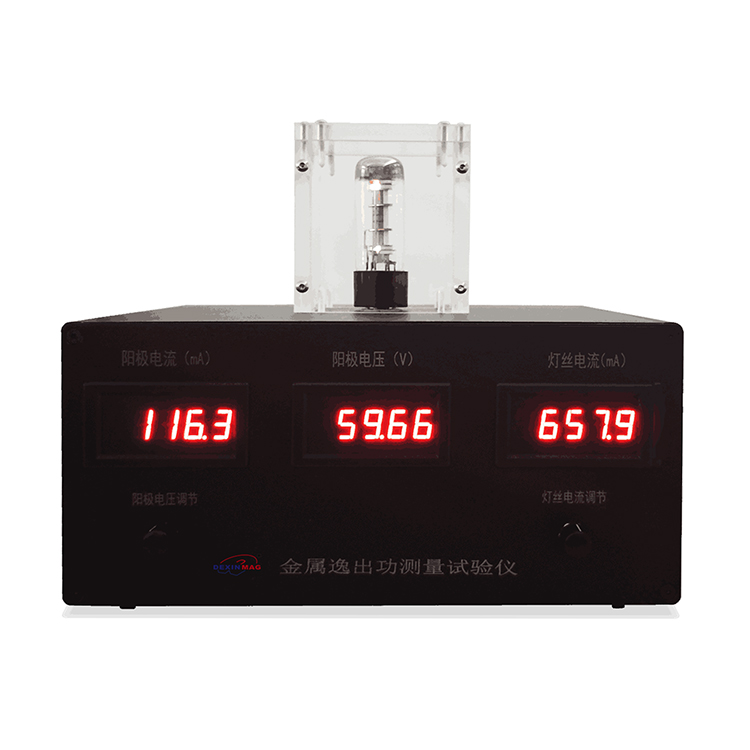


Metal Electron Work Function Tester
Instrument Composition:
The instrument consists of an experimental instrument and a metal diode mounted on top.
Features
The instrument's integrated design eliminates the need for complex wiring.
The diode is protected by a transparent housing and is resistant to damage.
Experimental Details
Measuring the electronic work function of metal tungsten using an ideal diode
Objectives
1. Understand the basic principles of thermionic emission and master a method for measuring the work function.
2. Determine the electronic work function of metal tungsten using the Richardson linear method.
3. Learn data processing techniques.
Specifications of Metal Electronic Work Function Tester
Standard (Ideal) Diode Specifications
Filament Material: Pure Tungsten
Filament Current: 0.5-0.82A
Filament Diameter: 7.5x10⁻⁵m
Anode Material: Nickel
Anode Length: 0.015m
Anode Inner Diameter: (9.0-9.2)*10-3m
Relationship Between Filament Temperature and Filament Current
| Filament Current Ir(A) | 0.52 | 0.56 | 0.60 | 0.64 | 0.68 | 0.72 | 0.76 | 0.80 |
| Filament TemperatureT(103K) | 1.93 | 2.00 | 2.07 | 2.14 | 2.21 | 2.28 | 2.35 | 2.42 |
Recommended filament current Ir for testing within the 0.56-0.76A range.
Filament current and anode voltage are adjustable based on diode specifications.
