


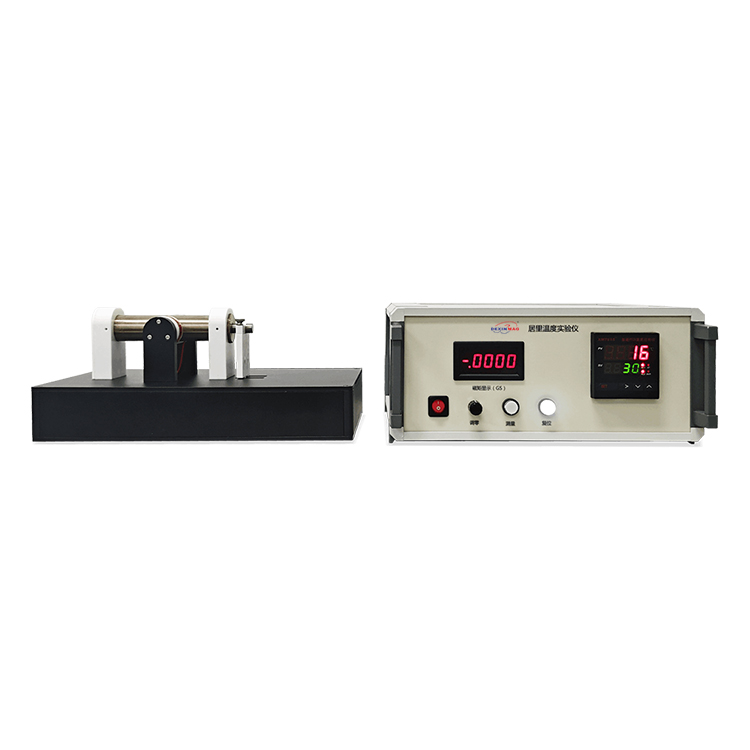
Curie Temperature Tester
Instrument Composition:
The instrument consists of a Curie temperature tester and a mechanical structure. The mechanical structure includes a heating device, temperature control and measurement devices, magnetization and detection devices, and air cooling devices.
Product Features
The instrument features a compact size and lightweight structure.
The temperature sensor and PID automatic temperature control ensure precise temperature measurements.
The integrated mechanical structure ensures stability and reliability.
Experimental Details
1. Measure the magnetic moment of NdFeB and pure nickel samples at different temperatures.
2. Plot the Curie temperature curve, calculate the Curie point, and verify the experimental principle of the Curie temperature test.
Experimental Objectives
1. Gain a preliminary understanding of the microscopic principles of the transformation of ferromagnetic materials from ferromagnetism to paramagnetism.
2. Learn the principles and methods of measuring the Curie temperature using a ferromagnetic material Curie temperature tester.
3. Learn how to measure the Curie point of different ferromagnetic samples.
Specifications of Curie Temperature Tester
| Power supply: | 220V/50Hz |
| Magnetic field strength: | 400GS |
| Heating power: | 105W |
| Temperature range: | Room Temperature 0-400°C |
| Temperature control accuracy: | ±1°C |
| Resolution: | 1°C |
| Integrator drift: | 1x100 scale: less than 30s per character |
| Integrator measurement accuracy: | Better than 2% |
| Sample size: | Φ 6x8 |
