


Seebeck Coefficient and Resistance Measurement System
Product Overview
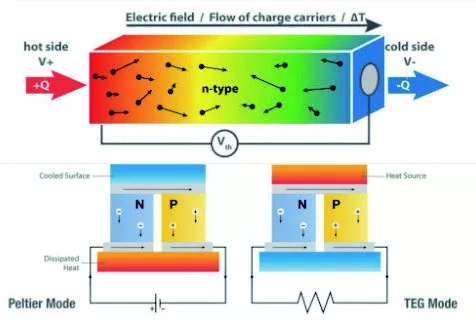
The thermoelectric effect describes the interaction between temperature and electricity in materials, and is based on three fundamental effects: the Seebeck effect, the Peltier effect, and the Thomson effect. The Seebeck effect, discovered in 1821 by German physicist J. T. Seebeck, describes the formation of an electric field when a temperature gradient is applied across an electrically insulating conductor. Conversely, the thermoelectric cooling effect describes the phenomenon of obtaining a temperature difference by applying an electric current. The efficiency of the conversion between electrical and thermal energy is a material property, characterized by the Seebeck coefficient S, which is temperature-dependent.
Currently, the increasing global warming caused by carbon dioxide emissions from fossil fuels, coupled with the problem of energy depletion, has led to widespread interest in using thermoelectric conversion elements to collect waste heat and utilize it effectively. In addition, thermoelectric cooling is an important application of thermoelectric properties.
With dwindling fossil fuel resources and increasing carbon dioxide emissions, and the resulting exacerbation of global warming, efficient thermoelectric conversion is becoming increasingly important. Thermoelectric generators (TEGs) are used to collect waste heat from heat engines (such as automobiles or conventional power plants) and convert it into electrical energy to improve their conversion efficiency. At the same time, applications of Peltier cooling are also gaining attention, such as in temperature-critical components in lasers and in advanced thermoelectric materials.
The thermoelectric conversion efficiency of a material is usually measured by the dimensionless figure of merit ZT, which is calculated from thermal conductivity, Seebeck coefficient, and electrical conductivity.
Therefore, Dexinmag has developed a series of simple, easy-to-use, and excellent material characterization instruments that can simultaneously measure the Seebeck coefficient and resistivity of samples in the temperature range from room temperature to 1500°C.
Thermopower, thermoelectric potential, or Seebeck coefficient all describe the magnitude of the induced thermoelectric voltage generated by a material under a certain temperature difference, with units of V/K.
Application Areas
Thermoelectric Material Development and Performance Optimization
• Measurement of Seebeck coefficient and electrical conductivity of thermoelectric materials such as semiconductors, skutterudites, etc., and calculation of ZT value (thermoelectric figure of merit).
• Evaluation of thermoelectric conversion efficiency of materials under high temperatures (e.g., 1500℃) or extreme environments (vacuum/reducing atmosphere).
Electronic and Functional Material Characterization
• Research on electrical transport properties of semiconductor thin films, conductive polymers, and metal oxides.
• Measurement of resistance-temperature relationship curves of high-temperature superconducting materials and ceramic matrix composites.
Energy Materials and Devices Research
• Analysis of resistivity and interface contact characteristics of lithium-ion battery electrode materials and solid electrolytes.
• Testing of conductive performance of fuel cell catalysts in oxidizing/reducing atmospheres.
Industrial Material Quality Control and Process Optimization
• Thermal-electrical synergistic performance testing of alloys, ceramics, and carbon materials to guide sintering process parameter adjustments.
• Evaluation of electrical behavior of high-temperature coatings and corrosion-resistant materials under simulated working conditions (e.g., vacuum, inert atmosphere).
Scientific Research and Standardization Testing
• Used by universities and research institutions for fundamental theoretical research on thermoelectric effects and conduction mechanisms.
• Conducting thermoelectric performance certification testing of materials according to international standards (e.g., ASTM E1225).
Testing Functions
Through the collaborative efforts of a team of experts and application engineers, Dexinmag has developed a new generation of intelligent measurement software. This software deeply integrates with the computer control system, is fully compatible with Windows 10/11 operating systems, and can automatically complete the entire process of signal excitation, data acquisition, real-time processing, and result output. It presents test results intuitively through a visual interface, significantly improving ease of operation and testing efficiency.
• Text editing
• Reduced input parameters for repeated measurements
• Real-time measurement and analysis
• Measurement curve comparison: up to 32 curves
• Curve subtraction
• Multiple analysis methods (DSC, TG, TMA, DIL, etc.)
• Curve zooming in and out
• First/second derivative calculation
• Multiple peak analysis
• Multi-point sample temperature calibration
• Multi-point enthalpy change calibration
• Heat flow Cp measurement
• Evaluation result saving and export
• ASCII data import and export
• Data generation to MS Excel
• Signal control measurement sequencing
Product Advantages
Wide Temperature Range Coverage and High Adaptability
• Supports an ultra-wide temperature range from room temperature (RT) to 1500℃, compatible with low-temperature to high-temperature testing, meeting the research needs of various materials such as thermoelectric materials and high-temperature alloys.
• Provides multiple atmospheric environments including inert, oxidizing, reducing, and vacuum, adapting to the performance evaluation of materials under different reaction conditions.
Precision and Multifunctional Integration
• Seebeck coefficient measurement range of 1–2500 μV/K, with an accuracy of ±7% and repeatability of ±3%, effectively capturing weak thermoelectric effects.
• Electrical conductivity measurement range covering 0.01–2×10⁵ S/cm, with an accuracy of ±5–8%, supporting resistivity analysis of all types of materials from insulators to conductors.
• Employs the static DC method (Seebeck coefficient) and the four-probe method (resistivity) to ensure stable and reliable measurement results.
Flexible Compatibility and Easy Operation
• Supports various sample sizes including cylindrical (φ6mm), prismatic (2–5mm face width), and disc-shaped (10–25.4mm), adapting to complex sample shapes.
• Adjustable probe distance (4/6/8mm) and sandwich clamping structure ensure stable sample contact and reduce measurement errors.
• Electrode materials are available in nickel (-100–500℃) or platinum (-100–1500℃), flexibly adapting to different temperature ranges and material characteristics.
High Stability and Long-Term Testing Capability
• Power supply output of 0–1A, with long-term stability, supporting continuous high-temperature experiments and long-term data acquisition.
• Equipped with K/S/C type thermocouples for effective temperature monitoring and closed-loop control.
Product Specifications
|
Product Model |
DXHCR1100 |
|
Temperature Range |
RT~800/1100/1500°C |
|
Measurement Principle |
Seebeck Coefficient: Static DC method; Resistivity: Four-probe method |
|
Atmosphere |
Inert, Oxidizing, Reducing, Vacuum |
|
Sample Holder |
Sandwich structure between clamp and two electrodes |
|
Sample Dimensions (Cylindrical or Prismatic) |
2 to 5 mm (face width), 23 mm; ф6 mm, 23 mm |
|
Sample Dimensions (Disk-shaped) |
10, 12.7, 25.4 mm |
|
Adjustable Probe Distance |
4, 6, 8 mm |
|
Seebeck Coefficient Measurement Range |
1~2500 μV/K; Accuracy ±7%; Repeatability ±3% |
|
Electrical Conductivity Measurement Range |
0.01~2*10⁵ S/cm; Accuracy ±5-8%; Reproducibility ±3% |
|
Power Supply |
0~1A, with long-term stability |
|
Electrode Material |
Nickel (-100 to 500°C) / Platinum (-100 to +1500°C) |
|
Thermocouple |
K/S/C type |
